Medically Reviewed by Dr Tan Ying Zhou (Dr YZ Tan) | November 2026
Quick Answer:
Your skin type can help guide which treatments are worth considering. Dry skin often benefits from hydration-focused options, oily skin may need treatments for pores, acne marks or texture, and combination skin may require different approaches for different areas. The right treatment still depends on your specific skin concerns and a proper assessment.
If you have ever searched for the best treatment for oily skin in Singapore, an aesthetic treatment for dry skin, or simply wondered, “Which aesthetic treatment suits my skin type?”, you may have noticed that the answers are rarely straightforward.
That is because your skin type is only one part of the picture.
Two people with oily skin may have very different concerns. One may mainly notice shine and enlarged pores, while another may be dealing with recurring acne and post-acne marks. Likewise, dry skin can mean persistent roughness for one person and dehydration with fine lines for another.
Understanding your baseline skin type can still be useful. It gives you a starting point for recognising what your skin may need and why certain treatments may be more appropriate.
Skin type generally describes how much oil and moisture your skin naturally produces and how these are distributed across the face.
The three types covered here are:
Your skin can also be dehydrated without being dry. Dehydration refers to a lack of water rather than oil, so even oily skin can sometimes feel tight or dehydrated.
Age, skincare, hormones, medications, sun exposure and the environment can also alter how your skin behaves over time. This is one reason a treatment plan should not be based on skin type alone.
A simple way to observe your skin is to cleanse your face gently, avoid applying skincare immediately afterwards and see how it feels after a short period.
Your skin may lean dry if:
Your skin may lean oily if:
Your skin may be combination if:
This checklist is only a guide. Persistent redness, scaling, acne, itching or sensitivity may reflect a skin condition rather than simply a skin type.
Singapore has a warm, humid climate throughout the year. Environmental conditions can influence both skin hydration and sebum production. Research suggests that moving repeatedly between hot, humid conditions and cooler, drier environments can affect skin hydration and sebum levels.
This means Singapore’s climate does not affect every skin type in the same way.
Heat and humidity may make shine and oiliness feel more noticeable. Sweat, sunscreen and makeup can also contribute to the heavy or congested feeling some people experience during the day.
High outdoor humidity does not automatically mean your skin cannot become dry or dehydrated. Long periods in air-conditioned environments may expose the skin to lower humidity, and research has linked low-humidity environments with reduced skin hydration and increased roughness.
The contrast can become more obvious. The T-zone may feel oily while other areas remain dry or dehydrated, particularly if skincare aimed at controlling oil is used across the entire face.
For dry skin, treatment usually centres on hydration and overall skin quality, particularly when dryness is accompanied by dullness, rough texture or early fine lines.
Skin boosters are injectable treatments designed to improve aspects of skin quality rather than change facial shape.
Hyaluronic acid-based skin boosters may be considered when dehydration is a prominent concern because hyaluronic acid attracts and retains water.
At Mizu, different categories of skin boosters may be considered depending on whether the priority is hydration, collagen stimulation or broader skin repair.
A bio-remodelling injectable may also be discussed when the aim is to improve hydration and overall skin quality.
These treatments use injectable hyaluronic acid formulations differently from conventional volumising fillers. Depending on the product and treatment protocol, the focus may be on supporting hydration, elasticity and skin quality rather than adding visible volume.
The suitability of an injectable treatment still depends on factors such as the condition of the skin, treatment area and individual medical history.
Not every dry-skin concern requires an injectable treatment.
For patients mainly dealing with temporary dehydration or surface dullness, a non-invasive facial focused on cleansing and hydration may sometimes be considered first.
The distinction matters because dry skin, dehydrated skin and structurally ageing skin are not the same problem. A doctor may recommend different approaches depending on what is actually causing the change you see or feel.
People looking for a facial for oily skin in Singapore often want one treatment that will “stop” oil production.
In practice, the more useful question is what comes with the oiliness.
Are there enlarged pores? Active acne? Acne marks? Uneven texture? Pigmentation?
Those accompanying concerns help determine whether an aesthetic procedure is appropriate.
RF microneedling combines fine needles with controlled radiofrequency energy delivered into the skin.
At Mizu, it is used for concerns including enlarged pores, acne scars and uneven texture.
For oily or acne-prone skin, it may be discussed when oiliness occurs alongside enlarged pores, active acne or acne scarring.
A Q-switched Nd laser may be considered when oily skin is accompanied by concerns such as acne marks, pigmentation or uneven skin tone.
The Q-switched laser used at Mizu operates at a wavelength of 1064 nm and can be adjusted for different skin concerns. Pigmentation, acne marks, pimples and acne are among its clinical uses.
This makes it more relevant when someone with oily skin is also concerned about the visible marks or pigmentation that acne can leave behind.
If oiliness is the only concern, however, a laser may not necessarily be the starting point.
Combination skin often benefits most from thinking in zones rather than one skin type for the entire face.
For example, you might have:
Using the same treatment everywhere may therefore not address each concern equally.
A doctor may instead use different treatment settings, focus different procedures on different concerns or combine compatible treatments as part of one protocol.
Yes. This is where combination treatment protocols may be particularly relevant.
One example available at Mizu is the Mizu Signature Radiance Revival, which combines three components:
The protocol is designed for patients with overlapping concerns such as enlarged pores, dryness, uneven texture, pigmentation and redness.
For combination skin, this type of approach illustrates why one treatment does not always need to do everything.
RF microneedling may be used to address concerns such as enlarged pores and texture, while the skin booster component adds hydration. The laser component is aimed at pigmentation and redness.
That does not mean everyone with combination skin needs all three treatments. A combination approach should only be used when the individual concerns justify it and the treatments can be combined appropriately.
Not by itself.
Skin type tells a doctor something about how your skin behaves, but several people with the same skin type may need completely different treatment plans.
A consultation may also take into account:
Not every dry patch, oily T-zone or enlarged pore needs an in-clinic procedure.
Daily skincare remains important for all skin types. Appropriate cleansing, moisturising and sun protection can often address mild concerns and help maintain the skin barrier.
An aesthetic treatment may be worth discussing when:
The role of aesthetic treatments is not to replace basic skincare. It is to address concerns that may benefit from procedures working at different depths or through mechanisms that topical products cannot reproduce.
Start with the concern, then use your skin type as additional context.
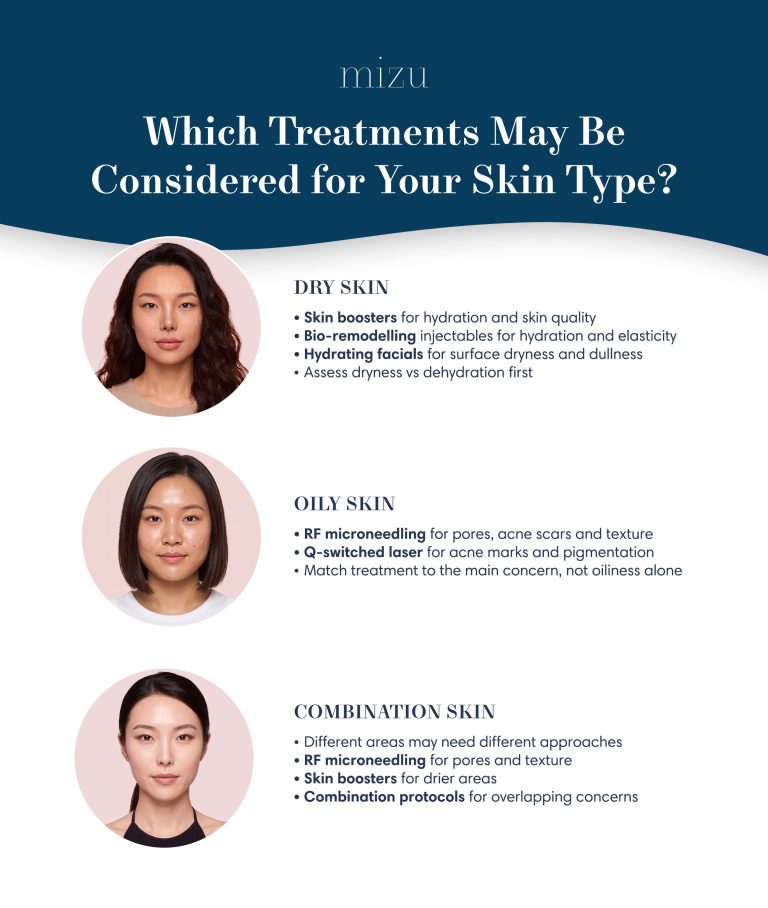
For dry skin, hydration-focused treatments such as skin boosters or bio-remodelling injectables may be discussed when improving skin hydration and quality is the priority.
For oily skin, RF microneedling may be considered when enlarged pores, acne or texture are part of the picture, while Q-switched laser treatment may be relevant when acne marks or pigmentation are more prominent.
For combination skin, treatment may need to account for different concerns in different areas rather than treating the whole face in exactly the same way. Combination protocols may also be considered when several concerns overlap.
A skin assessment helps distinguish between what is simply your baseline skin type and what may actually need treatment. You may book a consultation with Mizu Aesthetic to learn more.
There is no single treatment that suits everyone with oily skin. RF microneedling may be considered when oiliness occurs with enlarged pores, acne or acne scarring, while a Q-switched laser may be more relevant when acne marks or pigmentation are the main concern. A doctor should assess the underlying issue before recommending treatment.
Dry or dehydrated skin may be treated with options focused on hydration and skin quality, including hyaluronic acid-based skin boosters or bio-remodelling injectables. The appropriate treatment depends on whether the problem is surface dryness, dehydration, ageing-related changes or another skin condition.
Combination skin may require different approaches for different facial areas. A treatment plan may include RF microneedling for enlarged pores or texture, hydration-focused treatments for drier areas, or a carefully planned combination protocol when several concerns occur together.
Yes. Oiliness refers primarily to sebum production, while dehydration refers to insufficient water within the outer layers of the skin. It is possible for skin to produce excess oil while still feeling tight or dehydrated.
Heat and humidity can influence how much sebum is present on the skin and may make shine feel more noticeable. However, skin response varies between individuals, and air-conditioned environments can create a very different exposure during the same day.
No. Skin type itself does not require treatment. Aesthetic procedures are generally considered when there is a specific concern such as acne scarring, enlarged pores, pigmentation, persistent dehydration or uneven texture.
The information provided in this blog post is for educational and informational purposes only and should not be considered medical advice. Always consult with a healthcare professional or dermatologist before starting any new skincare routine or treatment, especially if you have existing skin conditions or concerns. Results may vary from person to person, and individual needs may require different approaches.
Dr Tan Ying Zhou, known as Dr YZ Tan, is the founder and Medical Director of Mizu Aesthetic Clinic.
His journey into aesthetics began with a medical degree from St. George’s, University of London, followed by an internship in Dermatology at the National Taiwan University Hospital.
Some of his favourite aesthetic procedures include nose augmentation and anti-ageing solutions, and he also serves as a trainer for emerging aesthetic doctors.
His philosophy revolves around personalised treatments tailored to each individual’s ageing concerns, aiming to transform the ageing process gracefully into a pleasant journey towards confidence and wellness.