XERF Radiofrequency Treatment Explained: What Is It, How Is It Different From HIFU, and Is It Right for You?

Home > Skin Concerns > XERF Radiofrequency Treatment Explained: What Is It, How Is It Different From HIFU, and Is It Right for You?
XERF Radiofrequency Treatment Explained: What Is It, How Is It Different From HIFU, and Is It Right for You?

Quick Answer:

XERF is a non-invasive radiofrequency (RF) treatment that uses two frequencies and selectable treatment depths to heat tissue beneath the skin and support collagen remodelling. Unlike HIFU, which uses focused ultrasound, XERF distributes RF energy across a broader area. Which treatment is appropriate depends on your skin, facial anatomy and treatment goals.

If your jawline looks less defined or the skin around your cheeks and neck feels looser, you may be exploring non-surgical skin-tightening treatments.

HIFU and Thermage are two familiar names. XERF is another option available for patients considering radiofrequency skin tightening in Singapore.

All three treatments use energy beneath the skin and aim to stimulate collagen remodelling without surgery. However, the way they deliver that energy is different, and this can influence which treatment your doctor recommends.

Key Takeaways

  • XERF is a non-invasive skin-tightening treatment that uses radiofrequency (RF) energy to heat different layers beneath the skin and stimulate collagen remodelling.
  • Unlike HIFU, which delivers focused ultrasound energy at specific depths, XERF uses RF to heat a broader area of tissue.
  • XERF may be considered for concerns such as mild to moderate skin laxity on the face and neck, early jowling, and fine lines.
  • One’s facial shape, skin laxity, facial volume, treatment goals, and tolerance for discomfort matter when choosing among XERF, HIFU, and Thermage.
  •  

What Is XERF Treatment?

XERF is a non-invasive skin-tightening treatment that uses radiofrequency energy to heat tissue beneath the skin. This controlled heating encourages collagen remodelling, which may gradually improve skin firmness and laxity, depending on the individual.

The name XERF is commonly expanded as eXperience Exponential RF. Unlike many RF devices that operate at a single frequency, XERF uses two frequencies, 6.78 MHz and 2 MHz, with shallow, middle and deep treatment settings. Depending on the selected setting, the device uses one or both frequencies, allowing the doctor to adjust RF delivery according to the treatment area and target tissue layer. 

XERF also incorporates Advanced Integrated Cryogen Delivery (ICD) Cooling and Wave Fit™ Pulse Technology. These features help manage heat at the skin surface while supporting the delivery of RF energy into deeper tissue layers.

Treatment can also be adapted to different parts of the face using four handpiece sizes. This is useful because areas such as the forehead, cheeks, jawline and around the eyes have different contours and tissue thicknesses. Instead of treating every area in the same way, the doctor can select the handpiece and settings that are more appropriate for the area being treated.

How Does a XERF RF Facial Treatment Work?

Think of XERF as creating controlled warmth beneath the skin.

The radiofrequency energy heats selected tissue layers while a built-in cooling system helps manage the temperature at the skin’s surface. This heat triggers a repair response in the tissue, including collagen remodelling. Changes therefore tend to develop progressively rather than appear immediately.

XERF does not involve needles or intentionally disrupt the skin’s surface. This is one reason why it generally involves less downtime than treatments that puncture or resurface the skin.

This also explains why a XERF RF facial treatment should not be confused with RF microneedling. Both use radiofrequency, but RF microneedling delivers RF through small needles inserted into the skin, whereas XERF delivers the energy externally.

What Can XERF Help With?

XERF may be considered when the main concern is skin that is beginning to feel or look less firm.

Concerns that may lead to a discussion about XERF include:

It is important to distinguish skin laxity from other causes of facial ageing.

For example, if your cheeks look flatter because you have lost facial volume, simply tightening the skin may not address the whole concern. Likewise, if fullness under the chin or heavier lower-face tissue is contributing to the appearance of jowls, your doctor may consider a different treatment approach.

XERF vs HIFU: What Is the Difference?

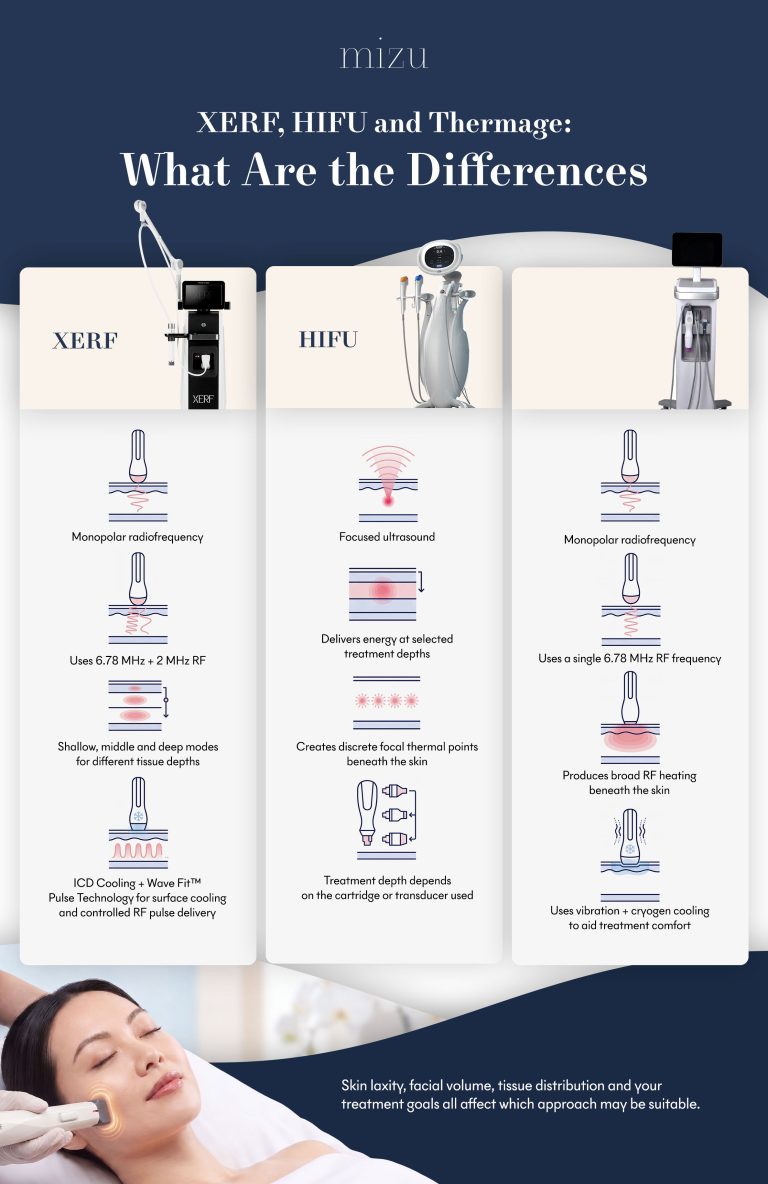
The main difference between XERF and HIFU is the type of energy they use and how that energy is delivered beneath the skin.

XERF uses radiofrequency, while HIFU uses focused ultrasound.

HIFU concentrates ultrasound energy into small treatment points at predetermined depths. Depending on the HIFU system and transducer used, the doctor can target different layers beneath the skin. 

XERF works differently. Rather than focusing energy at individual points, it uses RF to generate bulk heating across a broader volume of tissue beneath the skin, with settings that allow treatment at different depths.

XERF vs Thermage: Aren’t They Both RF?

Both XERF and Thermage use monopolar radiofrequency, but they differ in how the RF energy is delivered and adjusted during treatment.

Thermage uses a single RF frequency, so the doctor does not change treatment depth by switching between different RF frequencies. It uses different treatment tips for specific areas, such as the face and around the eyes, and combines vibration with cryogen cooling to help manage treatment comfort.

XERF uses two RF frequencies, 6.78 MHz and 2 MHz, which can be used individually or together. This allows the doctor to switch between shallow, middle and deep modes, delivering RF energy across different tissue depths, from the superficial dermis to deeper tissue planes, including the SMAS level. XERF also has four handpiece sizes designed to accommodate different facial contours and treatment areas.

The two devices also approach heat management differently. Thermage combines vibration with cryogen cooling, while XERF uses Advanced Integrated Cryogen Delivery (ICD) Cooling to cool the skin’s surface and Wave Fit™ Pulse Technology to control the delivery of each RF pulse as the tissue beneath is heated.

So while both are monopolar RF treatments, the main difference is that XERF allows treatment depth to be adjusted through its dual-frequency system, while Thermage uses a single RF frequency with different treatment tips and treatment settings.

XERF, HIFU and Thermage: What Is the Difference?

Treatment Comfort and Downtime with XERF

XERF generally produces a warming sensation during treatment, although the level of discomfort varies from person to person.

To help manage heat and comfort, the device uses two key features. Advanced Integrated Cryogen Delivery (ICD) Cooling cools the skin’s surface, while the Wave Fit™ Pulse system controls how each RF pulse is delivered as the tissue beneath is heated. At Mizu, topical numbing cream is also applied before treatment.

Because XERF does not break the skin, downtime is typically limited. Temporary redness or warmth may occur after treatment, but most patients can return to their usual activities afterwards.

If comfort or recovery time is an important consideration, especially if you have a lower pain threshold or an upcoming event, mention this during your consultation so it can be taken into account when planning treatment.

Which Skin Tightening Treatment Should I Choose?

After learning about XERF, HIFU and Thermage, it can be tempting to focus on which device reaches deeper or uses a particular type of energy. But those differences only matter when they are matched to the concern you are trying to address.

Before deciding on a treatment, it may help to consider:

  • Is my main concern loose skin, facial volume loss, heavier lower-face tissue or fine lines?
  • Which area of my face has changed the most?
  • Is preserving facial volume important to me?
  • Am I looking mainly for tightening, or is jowling or lower-face fullness also part of the concern?
  • How much discomfort or downtime am I comfortable with?

How Dr Tan Decides Which Treatment to Recommend

At Mizu, Founder and Medical Director Dr Tan Ying Zhou looks at how the face is ageing as a whole before deciding whether XERF, HIFU, Thermage or another treatment is more suitable.

The same concern, such as a less defined jawline, can come from very different changes.

During the assessment, he may look at whether the face is showing more of the following:

  • Loss of facial volume: The cheeks, temples or mid-face may look flatter or more hollow. In this situation, preserving existing facial fullness becomes an important consideration when choosing a tightening treatment.
  • Sagging or heavier lower-face tissue: Jowls, lower-face fullness or tissue descent may make the jawline look less defined or change the overall shape of the lower face.
  • Fine lines and general skin looseness: Reduced firmness, crepey skin or fine lines may become more noticeable as the skin loses elasticity and structural support over time.

Most patients have a combination of these changes. Someone may have early jowling together with volume loss, or fine lines alongside mild skin laxity. This is why Dr Tan also considers skin thickness, facial volume, tissue distribution, previous procedures, treatment goals and comfort preferences before recommending an approach.

The aim is to match the treatment to the changes contributing to your concern. If you are considering XERF, HIFU, or Thermage, you may book a consultation with Mizu to discuss which approach may be suitable for you.

Want to find out more?
Drop us a message with your enquiries or to book a consultation.

Frequently Asked Questions About XERF

1. Am I a good candidate for XERF?

You may be considered for XERF if you have mild to moderate skin laxity and are looking for a non-invasive tightening treatment.

Examples include early jowling, reduced firmness around the cheeks or jawline, loose skin around the neck, or fine lines. Your aesthetic doctor will assess your facial volume, tissue thickness, degree of sagging, previous procedures, and medical history to determine whether XERF is suitable for you.

2. Is XERF the same as HIFU?

No. XERF uses radiofrequency energy, while HIFU uses focused ultrasound. They both generate heat beneath the skin but distribute it differently.

3. Is XERF the same as Thermage?

No, although both are monopolar RF treatments. XERF uses two RF frequencies with several depth settings, while Thermage operates at a single RF frequency.

4. How long does a XERF treatment take?

At Mizu, treatment itself typically takes around 15 to 45 minutes, depending on the areas being treated. Numbing cream is applied and left on for approximately 30 minutes before treatment, so you should allow additional time for preparation.

5. When will I notice a change after XERF?

XERF works partly through collagen remodelling, so changes tend to build gradually rather than all at once. You may begin to notice improvements after 4 to 6 weeks, with collagen remodelling continuing for up to 6 months. Results vary depending on factors such as skin condition, lifestyle and sun exposure.

6. How many XERF sessions do I need?

Individuals may undergo 1 session approximately every 9 months, although the recommended interval may vary depending on the degree of skin laxity and your doctor’s assessment. 

7. Can XERF replace HIFU or Thermage?

Not necessarily.

XERF gives doctors another way to deliver RF skin tightening at different depths, but it does not make HIFU or Thermage redundant. HIFU, XERF, and Thermage each deliver energy differently and may suit different facial structures and concerns.

Dr Tan Ying Zhou | Mizu Doctor
Wave Logo | Mizu

Disclaimer

The information provided in this blog post is for educational and informational purposes only and should not be considered medical advice. Always consult with a healthcare professional or dermatologist before starting any new skincare routine or treatment, especially if you have existing skin conditions or concerns. Results may vary from person to person, and individual needs may require different approaches.

Dr Tan Ying Zhou, known as Dr YZ Tan, is the founder and Medical Director of Mizu Aesthetic Clinic.

His journey into aesthetics began with a medical degree from St. George’s, University of London, followed by an internship in Dermatology at the National Taiwan University Hospital.

Some of his favourite aesthetic procedures include nose augmentation and anti-ageing solutions, and he also serves as a trainer for emerging aesthetic doctors.

His philosophy revolves around personalised treatments tailored to each individual’s ageing concerns, aiming to transform the ageing process gracefully into a pleasant journey towards confidence and wellness.

Book Your Consultation With Us