Do You Need Invasive Skin Lifting? What an Aesthetic Doctor Wants You to Know

Home > Skin Concerns > Do You Need Invasive Skin Lifting? What an Aesthetic Doctor Wants You to Know
Do you need invasive skin lifting? What an aesthetic doctor at Mizu Aesthetic Clinic Singapore wants you to know about non-surgical facelift options and when surgery may be discussed.

Written & reviewed by Dr Tan Ying Zhou (Dr YZ Tan) | Last reviewed: October 2026

Quick Answer:

Not everyone concerned about facial sagging needs facelift surgery. Non-invasive treatments may be considered for mild to moderate laxity when the expected degree of change is within what energy-based treatments can provide. These treatments use ultrasound, RF or laser energy to stimulate collagen and improve tissue firmness at different depths. A facelift works differently because surgery can reposition deeper tissues and remove excess skin.

If you are noticing early jowling, reduced jawline definition or downward movement of the cheeks, you may wonder whether a non-invasive treatment is enough or whether facelift surgery is more appropriate.

At Mizu Aesthetic Clinic, Founder and Medical Director Dr Tan Ying Zhou assesses what is contributing to the change first. Skin laxity, tissue descent, facial volume and skin quality can produce similar concerns but may need different approaches.

This distinction is important when looking at the differences between facelift surgery and non-invasive treatments such as HIFU, radiofrequency (RF), Sofwave and laser-based lifting.

Key Takeaways

  • A “non-surgical facelift” does not work in the same way as facelift surgery.
  • Mild to moderate laxity may sometimes be addressed with non-invasive treatments.
  • Skin laxity, tissue descent, facial volume and skin quality should be assessed separately.
  • Different technologies target different tissue depths and concerns.
  • More pronounced tissue descent or excess skin may be beyond what non-invasive lifting can address.

What Is Actually Causing the Face to Look Different?

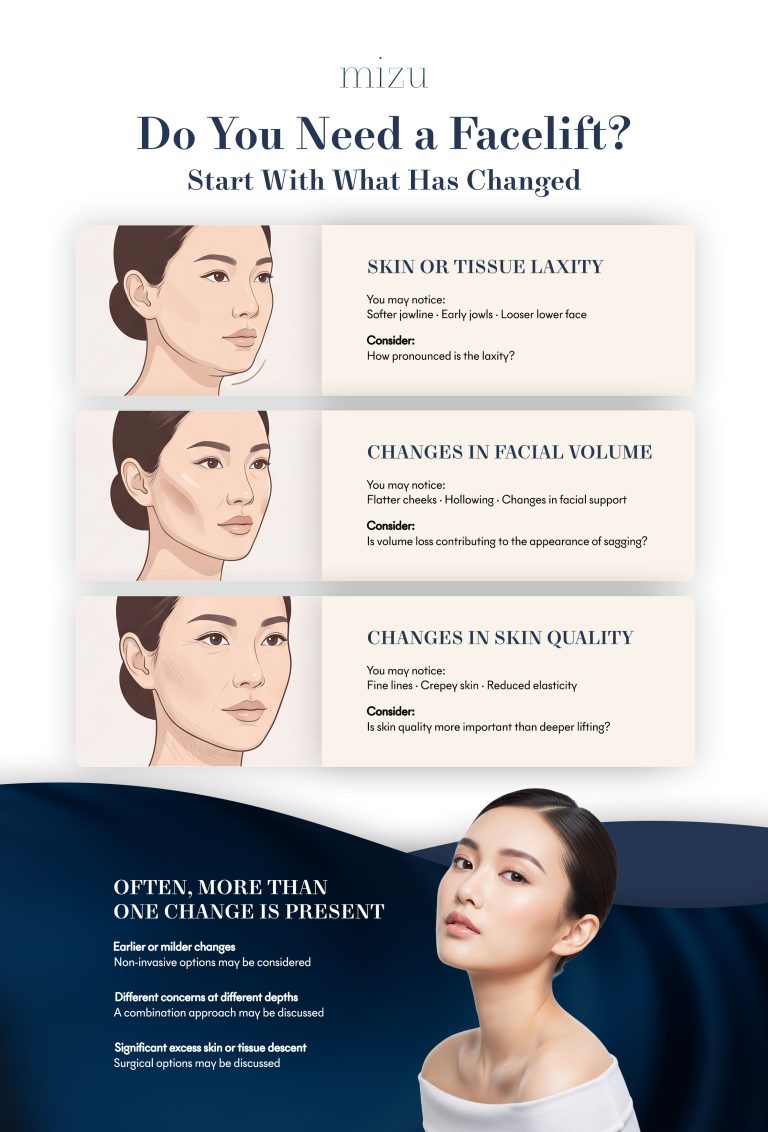
Facial ageing does not involve the skin alone. For some patients, skin and soft-tissue laxity are the main concerns. This may appear as early jowling, reduced jawline definition or looser skin around the lower face and neck. These changes can also affect facial proportions and jawline definition, which may contribute to concerns about achieving a more V-shaped face.

For others, facial volume has changed. Flatter cheeks or changes in fat distribution can alter facial proportions, which means tightening alone may not address the concern.

Fine lines, crepey skin and reduced elasticity may instead point towards skin-quality changes rather than deeper tissue descent.

Many patients have several of these changes at once. This is why treatment planning should start by identifying what is contributing to the appearance of sagging rather than selecting a device or treatment first.

When May Non-Invasive Lifting Be Considered?

Non-invasive treatments may be discussed when laxity is mild to moderate and the patient is looking for tightening without significant downtime.

This may include:

  • early jowling
  • softening of the jawline
  • mild to moderate facial or neck laxity
  • reduced skin firmness
  • early loosening around the lower face
  • a preference to avoid surgical recovery

Age alone does not determine suitability. Facial structure, skin thickness, volume distribution, genetics, weight changes and previous treatments all affect how the face ages.

Expectations also matter. Someone seeking a modest improvement in firmness may have different treatment options from someone looking for substantial repositioning of descended tissue or correction of significant loose skin.

Different lifting technologies use different forms of energy and target different tissue depths.

Main concern Treatment that may be discussed General treatment focus
Lower-face sagging, early jowling or reduced jawline definition HIFU such as Ultraformer MPT or Ultherapy Focused ultrasound at selected depths to stimulate collagen remodelling and tissue tightening
Loose or crepey skin where deeper lifting is not the main concern Sofwave Ultrasound energy targeting the mid-dermis to stimulate collagen
Skin laxity Thermage Monopolar RF heating to stimulate collagen remodelling
Mild to moderate laxity across different depths XERF RF Skin Tightening Dual-frequency monopolar RF with treatment modes targeting different depths
Earlier laxity or firmness concerns Soprano Titanium Lifting Triple-wavelength diode laser delivered in moving passes to heat tissue and support collagen stimulation
Facial volume loss Dermal fillers or other volume-related treatments, where appropriate Addressing volume rather than relying on tightening alone
Hydration, fine lines or skin-quality concerns Skin boosters or other skin treatments Improving skin quality rather than deeper lifting

These categories can overlap. A doctor may sometimes discuss more than one treatment when different ageing changes are present, but each treatment should have a specific purpose. Learn more about how Soprano Titanium Lifting works and where it may fit within a skin-lifting treatment plan.

For example, HIFU or RF may address laxity while a separate treatment is considered for skin quality. Similarly, skin boosters may help with hydration or fine lines but should not be expected to perform the same role as a lifting treatment. 

If you are considering RF-based lifting, our guide to XERF Radiofrequency Treatment explains how it works, how it differs from HIFU, and what factors may influence whether it is suitable.

When Might Non-Invasive Lifting Not Be Enough?

For some people, repeatedly changing devices or adding non-invasive treatments may not address the underlying issue.

A doctor may be more cautious about relying on non-invasive lifting when:

  • there is significant loose or excess skin
  • jowling or tissue descent is more pronounced
  • the ageing change is primarily structural
  • previous non-invasive treatments have produced limited improvement
  • the degree of change being sought is beyond what energy-based treatments can reasonably provide

At this stage, speaking to a plastic surgeon may provide a clearer understanding of the surgical options.

That does not mean surgery is automatically necessary. It means recognising when a non-invasive treatment may not be designed to deliver the degree of correction being sought.

How Do Aesthetic Doctors in Singapore Decide What Level of Treatment to Consider?

At Mizu Aesthetic Clinic, our aesthetic doctor first assesses what is contributing to the concern before considering treatment options. This may include:

  • Where is the change? Is it mainly around the cheeks, jawline, jowls, neck or skin surface?
  • What is causing it? Skin laxity, heavier tissue, volume loss, reduced skin quality or a combination?
  • How pronounced is it? Early facial changes and more significant tissue descent require different approaches.
  • What degree of change is the patient looking for? It may be a subtle improvement or a substantial repositioning.
  • How much downtime is acceptable? Some patients want to avoid a long recovery time, while others may prioritise the degree of correction.
  • What has already been tried? Previous treatments and how the face responded can influence what is considered next.

This is why two people with apparently similar jowls may receive very different recommendations. One may mainly have early tissue laxity and be suitable for a lifting treatment. Another may have laxity together with changes in skin quality.

For someone else, loss of facial volume may be contributing significantly to the appearance of sagging, meaning that additional tightening alone may not address the main issue.

Do You Need a Facelift? - Infographic | MIZU

So, Do You Need Invasive Skin Lifting?​

For mild to moderate skin laxity, surgery may not be the first option to consider. Non-invasive treatments such as HIFU, RF, Sofwave or laser-based lifting can target different tissue depths to stimulate collagen and improve firmness without surgical incisions or recovery.

The choice depends on what is contributing to the facial change. Some patients may benefit from one lifting treatment, while others may need a combination approach to address laxity, volume changes or skin quality.

A surgical opinion becomes more relevant when there is substantial excess skin or pronounced tissue descent that non-invasive treatments are not designed to correct.

If you are unsure where your concerns fall, the starting point is to identify:

  • what is causing the change
  • how pronounced the laxity is
  • which tissue layers are involved
  • what degree of improvement you are looking for

An aesthetic doctor can then assess whether a non-invasive treatment or combination of treatments is appropriate for your concerns. You may book a consultation with Mizu Aesthetic to learn more.

Want to find out more?
Drop us a message with your enquiries or to book a consultation.

Frequently Asked Questions

1. What is a non-surgical facelift in Singapore?

“Non-surgical facelift” is a broad term for treatments intended to improve facial firmness, laxity or contours without facelift surgery. Options may include HIFU, other ultrasound-based treatments such as Sofwave, RF or laser-based treatments. They do not remove excess skin or reposition facial tissues in the same way as surgery.

2. Do I need facelift surgery for jowls?

Not necessarily. Early jowling may sometimes be considered for non-invasive treatment, but jowls can also be affected by tissue descent, facial volume, fat distribution and anatomy. More pronounced changes may fall outside what tightening treatments can address.

3. Can HIFU replace a facelift?

HIFU may be considered for mild to moderate laxity, but it does not reproduce facelift surgery. HIFU stimulates collagen remodelling, while surgery can reposition underlying tissues and remove excess skin.

4. What is the difference between non-invasive and surgical lifting?

Non-invasive treatments use energy such as ultrasound, RF or laser to stimulate collagen and affect tissue firmness without surgical incisions. Facelift surgery can reposition deeper tissues, redrape the skin and remove excess skin.

5. Can HIFU and RF be used together?

They may sometimes be considered within the same treatment plan because they deliver energy differently. Combining them is not necessary for everyone, and each treatment should have a clear purpose.

6. At what age should someone consider a facelift?

There is no fixed age. Suitability depends more on facial anatomy, the degree of skin excess and tissue descent, general health and the amount of correction being sought.

Dr Tan Ying Zhou | Mizu Doctor
Wave Logo | Mizu

Disclaimer

The information provided in this blog post is for educational and informational purposes only and should not be considered medical advice. Always consult with a healthcare professional or dermatologist before starting any new skincare routine or treatment, especially if you have existing skin conditions or concerns. Results may vary from person to person, and individual needs may require different approaches.

Dr Tan Ying Zhou, known as Dr YZ Tan, is the founder and Medical Director of Mizu Aesthetic Clinic.

His journey into aesthetics began with a medical degree from St. George’s, University of London, followed by an internship in Dermatology at the National Taiwan University Hospital.

Some of his favourite aesthetic procedures include nose augmentation and anti-ageing solutions, and he also serves as a trainer for emerging aesthetic doctors.

His philosophy revolves around personalised treatments tailored to each individual’s ageing concerns, aiming to transform the ageing process gracefully into a pleasant journey towards confidence and wellness.

Book Your Consultation With Us