Soprano Titanium Lifting (TL) in Singapore: 5 Things Your Aesthetic Doctor Wants You to Know Before Your First Session

Home > Skin Concerns > Soprano Titanium Lifting (TL) in Singapore: 5 Things Your Aesthetic Doctor Wants You to Know Before Your First Session
Soprano Titanium Lifting (TL) in Singapore: 5 Things Your Aesthetic Doctor Wants You to Know Before Your First Session | MIZU

If you have been looking into skin tightening treatments, you may have come across Soprano Titanium Lifting alongside options such as HIFU and Radiofrequency.

They are often grouped because they all use energy to heat tissue, but that does not mean they work in the same way.

Soprano Titanium Lifting is a triple-wavelength diode laser treatment. It uses laser energy rather than radiofrequency or ultrasound, and the way that energy is delivered matters just as much as the machine being used.

Here are five things worth knowing before your first Soprano Titanium Lifting session.

1. Soprano Titanium Lifting Is a Laser Treatment, Not Radiofrequency (RF)

One of the most common misconceptions about Soprano Titanium Lifting is that it is a radiofrequency treatment.

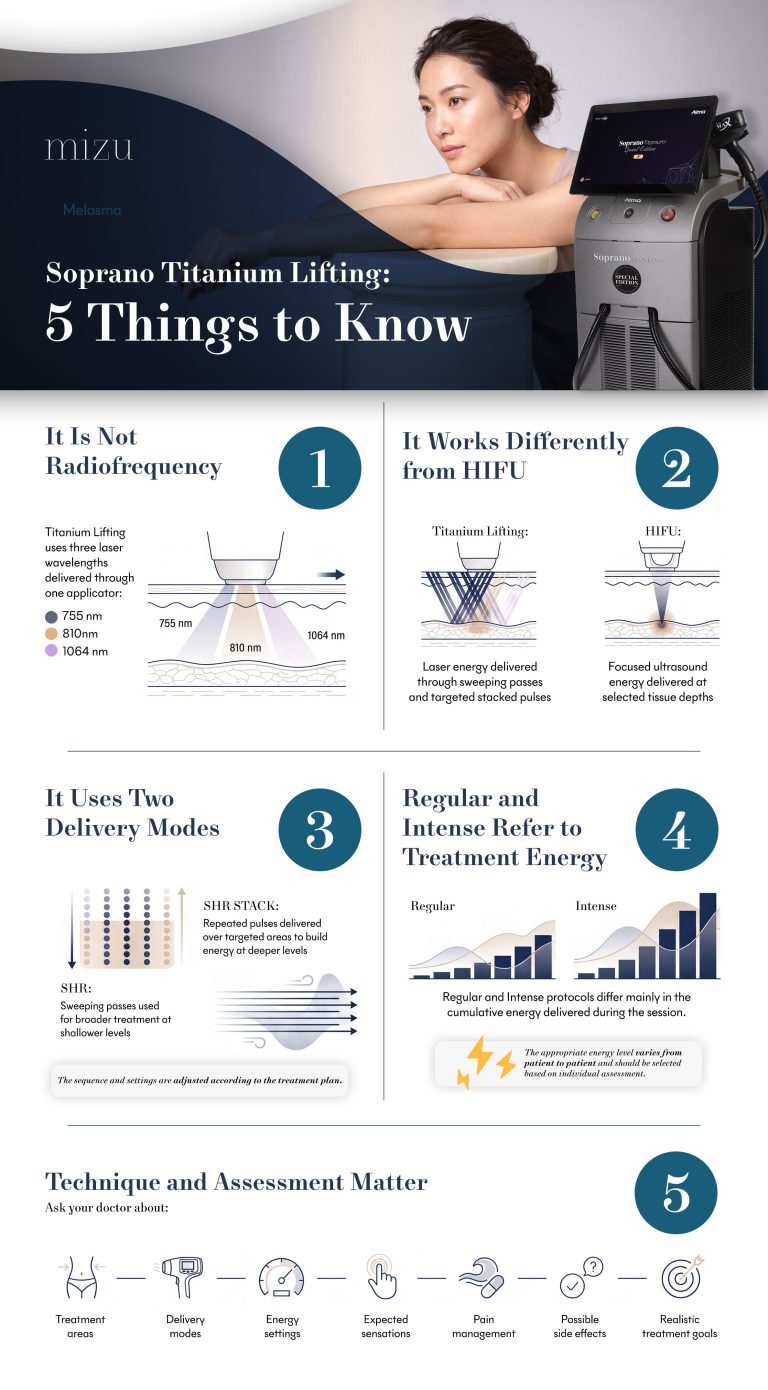
It uses three diode laser wavelengths, namely 755 nm, 810 nm and 1064 nm, delivered through the same applicator. This triple-wavelength platform is used in laser hair removal and has also been studied for facial contouring and skin rejuvenation.

Why use three wavelengths?

Different wavelengths travel through tissue differently. Rather than relying on a single wavelength, Soprano Titanium Lifting combines them during treatment so that energy is distributed across different tissue levels.

The treatment works by gradually heating the treated area. This thermal effect is used to support skin tightening and contouring, while collagen remodelling may continue after the session. However, the degree of change varies between individuals.

2. Soprano Titanium Lifting Does Not Work the Same Way as HIFU and Radiofrequency Treatments

The main difference lies in the type of energy used and how that energy is distributed through the tissue. Radiofrequency treatments use electrical energy to generate heat in the tissue, while Soprano Titanium Lifting uses laser energy and HIFU uses focused ultrasound.

Soprano Titanium Lifting

Soprano Titanium Lifting generally involves moving the handpiece continuously across the skin, with repeated passes gradually building heat within the treatment area.

Each of its three wavelengths penetrates different depths. The longer 1064 nm wavelength penetrates more deeply than the shorter 755 nm wavelength, while 810 nm reaches an intermediate depth. Rather than switching between each wavelength, the device delivers all three simultaneously to support skin tightening, facial contouring and improvements in overall skin tone. 

HIFU

HIFU delivers focused ultrasound energy at specific depths. Depending on the device and cartridge selected, it may target the dermis, subcutaneous layers or the superficial musculoaponeurotic system (SMAS) to support skin tightening and lifting. 

Rather than gradually heating a broad area through continuous passes, HIFU creates individual thermal coagulation points along planned treatment lines.

Radiofrequency

Radiofrequency treatments use electrical energy to generate controlled heat within the skin. This thermal energy helps stimulate collagen remodelling and new collagen production, which may gradually improve skin firmness and texture over time. Some RF devices are applied directly to the skin’s surface, while RF microneedling devices use fine needles to deliver energy at selected depths within the skin. 

How Do the Treatments Feel?

The experience varies with the device, settings, treatment area and individual tolerance.

Soprano Titanium Lifting usually feels progressively warm, sometimes with tingling or tenderness as the handpiece moves repeatedly over the skin. The applicator includes a cooling function that helps manage surface temperature during energy delivery. 

HIFU may cause brief pulses of heat, tingling or discomfort as each ultrasound line is delivered. RF may feel progressively warmer as heat builds across the treatment area, while RF microneedling may involve pressure and a prickling sensation as the needles enter the skin and deliver energy.

Which treatment is considered depends on factors such as:

  • The degree and location of skin laxity
  • Facial volume and fat distribution
  • Skin and tissue thickness
  • Previous aesthetic procedures
  • Treatment tolerance
  • The concern being addressed

A consultation helps identify what is causing the visible concern, as skin laxity, volume loss, muscle activity and facial fat may appear similar but require different treatment approaches.

3. A Soprano Titanium Lifting Session Is Delivered in Two Modes

The triple-wavelength technology is delivered in two modes: SHR Stack and SHR. 

The first stage uses SHR Stack mode, which is intended to deliver heat into deeper tissue levels. The doctor moves the applicator across the planned facial areas using a stamping technique. Multiple pulses are delivered at each selected point before the applicator is moved to the next area, allowing energy to be delivered in a controlled and systematic manner.

The doctor then monitors the patient’s response throughout the treatment. Sensations may include warmth, tingling and mild tenderness.

The second stage uses SHR mode, which delivers repeated pulses of energy while the handpiece is moved in a continuous sweeping motion. This stage targets the superficial tissue layers, with heat building gradually as the handpiece passes repeatedly over the treatment area to provide broader, more even coverage.

Why does technique matter?

Technique influences how evenly the energy is distributed. If the handpiece moves too quickly, skips areas or completes too few passes, some parts of the face may receive less energy than intended. If it moves too slowly or remains over one area, heat may accumulate unevenly.

Patients may ask:

  • Which areas will be treated?
  • How many treatment steps are included?
  • Which mode will be used?
  • How is the total energy recorded?
  • How will the doctor monitor discomfort and skin response?

What about numbing cream?

At Mizu, topical numbing cream is used before Soprano Titanium Lifting to make the treatment more comfortable as warmth gradually builds.

This can be helpful because the treatment relies on delivering a planned amount of energy over the session. If a patient becomes too uncomfortable, the doctor may need to pause or lower the settings. Numbing cream can help reduce that discomfort so the treatment can be carried out as planned.

The doctor will determine the treatment settings based on the patient’s skin, facial anatomy, treatment area and previous procedures, and monitor how the patient is responding throughout the session.

The purpose of the numbing cream is to make the experience more comfortable while keeping the treatment appropriate for the patient.

4. Regular and Intense Soprano Titanium Lifting Differ in Total Energy

Regular and Intense Soprano Titanium Lifting differ in the total amount of energy delivered during the session. 

The Intense protocol delivers a higher cumulative energy dose through additional passes, adjusted settings or a longer treatment sequence than the Regular protocol. 

Who may be considered for Regular Soprano Titanium Lifting?

The Regular protocol may be considered for patients looking at routine maintenance or to complement their other treatments. 

A regular protocol may be considered where:

  • Skin laxity is relatively mild
  • The patient is new to the treatment
  • A conservative starting approach is preferred
  • Heat tolerance is lower
  • A smaller area is being treated

Any increase in energy during treatment is assessed and determined by the doctor based on the patient’s response. 

Who may be considered for Intense Soprano Titanium Lifting?

A higher-energy protocol may be considered for patients who:

  • Have more noticeable laxity or contour concerns
  • Require treatment over a larger area
  • Have been assessed as suitable for greater cumulative energy

It’s important to note that higher total energy does not mean it is more effective for every patient. The appropriate energy level varies from patient to patient and is based on an individualised treatment plan.

5. Soprano Titanium Lifting May Not Be Suitable for Every Facial Concern

The first step is to check whether the concern is something Soprano Titanium Lifting is suited to address, because not every change in facial appearance is caused by skin laxity.

For example:

  • Reduced facial volume may relate to fat or bone changes.
  • Lower-face heaviness may be influenced by fat distribution.
  • Fine lines may be related to sun damage or repeated facial movement.
  • A less defined jawline may involve the skin, fat, muscle or underlying facial structure.
  • Uneven skin tone may need a different laser approach if the goal is to treat specific pigment spots.

Soprano Titanium Lifting may help with concerns such as mild skin laxity, facial contour and overall skin radiance. Although it is a laser treatment, it is not intended for targeted spot treatment of pigmentation. Its effect on skin tone is broader, with some patients noticing a brighter and more even-looking complexion after treatment.

Before treatment, it can be helpful to ask the doctor:

  • Which concern is the treatment intended to address?
  • Which facial areas will be treated?
  • How will the treatment settings be selected?
  • What degree of change may reasonably be expected?
  • What concerns is the treatment unlikely to address?

It can also be helpful to understand how changes will be evaluated. This may include:

  • Skin firmness
  • Lower-face contour
  • Jawline definition
  • Overall skin brightness and radiance
  • How even the skin tone appears
  • Standardised photographs
  • Patient-reported changes

Ask About Limitations and Possible Side Effects

Possible effects include warmth, redness, tenderness and swelling. Their severity and duration vary according to the procedure, treatment settings and individual response.

Let your doctor know about:

  • Active skin infections or inflammation
  • Recent laser or energy-based procedures
  • Injectable treatments in the same area
  • Medicines that may affect healing or skin sensitivity
  • Pregnancy or breastfeeding
  • Implanted medical devices
  • Any previous unusual reactions to heat or laser treatments

Understanding Soprano Titanium Lifting

If you are considering Soprano Titanium Lifting in Singapore, it helps to understand what the procedure entails, how it differs from other skin tightening treatments, and how the treatment plan may be adjusted from one patient to another. 

A consultation can help determine whether this aesthetic treatment is suitable, explain the available options, and guide you towards an informed decision based on medical assessment. Book a consultation with us to learn more. 

Soprano Titanium Lifting: 5 Things to Know | MIZU
Want to find out more?
Drop us a message with your enquiries or to book a consultation.

Frequently Asked Questions About Soprano Titanium Lifting

1. Is Soprano Titanium Lifting the same as radiofrequency treatments?

No. Soprano Titanium Lifting uses 755 nm, 810 nm and 1064 nm diode laser wavelengths. Radiofrequency treatments use electrical energy to generate heat.

2. What is the difference between Soprano Titanium Lifting and HIFU?

Soprano Titanium Lifting uses three diode laser wavelengths, while HIFU uses focused ultrasound. Titanium Lifting generally involves two types of passes: stamping and sweeping, depending on the treatment mode. HIFU places focused treatment points at selected depths.

3. What are SHR and SHR Stack in Soprano Titanium Lifting?

At Mizu, SHR Stack uses repeated pulses with a stamping technique to build energy over targeted areas, while SHR uses continuous sweeping movements across the skin at superficial tissue levels.

4. Does Soprano Titanium Lifting require numbing cream?

At Mizu, we provide numbing cream to help manage patient comfort and tolerance, allowing for optimal treatment delivery without discomfort becoming a limiting factor.

5. What does Soprano Titanium Lifting feel like?

Patients may experience warmth, tingling or a prickly sensation as energy is delivered. Sensation varies according to the treatment area, settings and individual tolerance.

6. How many Soprano Titanium Lifting sessions are needed?

At Mizu, we suggest around four to six sessions spaced approximately one to two months apart.

Dr Tan Ying Zhou | Mizu Doctor
Wave Logo | Mizu

Disclaimer

The information provided in this blog post is for educational and informational purposes only and should not be considered medical advice. Always consult with a healthcare professional or dermatologist before starting any new skincare routine or treatment, especially if you have existing skin conditions or concerns. Results may vary from person to person, and individual needs may require different approaches.

Dr Tan Ying Zhou, known as Dr YZ Tan, is the founder and Medical Director of Mizu Aesthetic Clinic.

His journey into aesthetics began with a medical degree from St. George’s, University of London, followed by an internship in Dermatology at the National Taiwan University Hospital.

Some of his favourite aesthetic procedures include nose augmentation and anti-ageing solutions, and he also serves as a trainer for emerging aesthetic doctors.

His philosophy revolves around personalised treatments tailored to each individual’s ageing concerns, aiming to transform the ageing process gracefully into a pleasant journey towards confidence and wellness.

Book Your Consultation With Us